1_resize.jpg)

Click on image for a larger version

 | ||||||||||
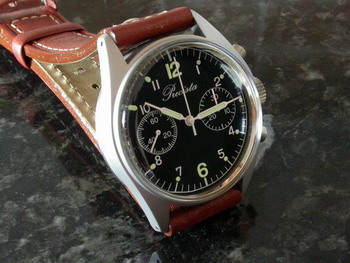
Precista PRS-5 Introduction Despite having owned more than one chronograph over the years I would state at the outset that chronographs have never been my first choice for everyday wear. However, when I need to wear a chronograph through necessity then my choice is always one equipped with hands as opposed to a 1/100 seconds digital affair with a plethora of lap times and so on. I do not need that functionality and as with many people (possibly of my own generation but it seems increasingly with younger generations) then I am increasingly attracted to those things simple and traditional. I allude for one moment to an Oris catalogue that I read in the late 1990s which stated something along the lines of the ‘fact’ that a mechanical chronograph is more accurate than a digital chronograph at measuring very short periods of time. Indeed, I saw reference to this on a watch forum and it made me smile to the point that I made a reply stating what I thought the facts to be: it is not the mechanical chronograph itself that is more accurate at measuring these periods; rather, it is the perception of the human eye in reading a moving hand and anticipating a button push in order to stop measurement at a given point on a dial. A quartz driven timepiece of almost any type is more accurate but in practical situations of relatively short duration then something ‘clockwork’ can be more than adequate and of course give the user that feeling of using a real machine as opposed to a soul-less, silicon chip based mini computer. As with many items intended for practical use, often (but certainly not always) one can look to the military for examples of design simplicity which by default enable ease of use. Wristwatches are in my opinion one such product; there is (again, in my opinion) nowhere else to look but at what is, or has been issued by the military in order to select a visual design that is fit for purpose. Indeed, many watch manufacturers have done just this and taken the military ‘look’ and marketed whole ranges of watches based upon this. An injection of ‘fashion’ means that at the time of writing then these nods to military design have been christened with some interesting names (unfortunately, emblazoned on the dial in some cases) and have it seems, been given a course of steroids with diameters approaching what might be for many people the un-wearable. Certainly in my case, I have a liking for the no nonsense, wearable proportions, easy time reading and ‘rugged functionality’ of military designs. Perhaps I am stating the obvious given other timepieces that I have owned or reviewed but the point being made is that I am prepared to wait for what I feel meets my requirements exactly before I outlay any money. Furthermore and just as importantly, I really do need a watch to excite me in some way before I feel any justification in owning one. In the past, the UK Ministry of Defence (MOD) had requirements for wrist chronographs which were met by various manufacturers including Lemania, Hamilton, CWC, Newmark and Precista. As with other forms of wristwatch, the military specification was relatively detailed and included drawings of how the required timepiece might look. It was not therefore unusual for watches procured from various manufacturers to look almost exactly the same. Today’s military watch collectors will often have the goal of owning one of each of a model which for all intents and purposes, is identical bar the name on the dial. Given this and the finite supply of genuine issued watches from the 1960s through to the early 1980s, then prices are ‘on the up’ so to speak and continue to be so. In the early 1990s, British military chronographs were still relatively easy to buy as surplus equipment as opposed to collector’s items. My first brush with them came in the form of a printed stock list from a UK surplus supplier and it was the simple look and functionality that attracted me to the concept, as opposed to the watches themselves. I wanted something new, dependable and unworn. It wasn’t until around 1997 or 1998 that I discovered the ‘new’ CWC chronograph. Immediately I saw the watch that was manufactured by the company that continues to supply the UK MOD then I thought that it might well be worth owning and indeed I did so for a while but I was never comfortable with either the dial layout (sub dials at 9 and 12) or the price tag. Thus, the CWC departed. CWC do in fact now offer what the company quaintly refers to as a ‘remake’ of the originally issued mechanical chronograph which is visually very impressive (sub dials are at 3 and 9) but at £699.00 I feel is pushing the limits of reasonableness and is capitalising on the military connection. As with many watches I own, the aura or the concept is just as important as the watch itself. In the past, I have bought watches which have been a modern version of those which I may have come into contact with in the past or indeed which have some connection with my interests in aviation. In the past, I would make regular visits to RAF Cosford Air Museum; walking around the hangars in those days one could almost hear the roar of the Canberra’s Avon engines. Many of the military aircraft there were of the age of ‘clockwork’ – indeed, an ex RAF navigator I once knew always alluded to the Canberra as the ‘Princess of the skies’ and made great store of the fact that equipment in the nav bay was ‘clockwork with cogs and springs’. As a small aside, he was still wearing his issued Seiko 7T27 quartz chronograph which in fact replaced the ‘clockwork with cogs and springs’ chronographs which Precista et al supplied until the early 1980s. I have often wondered what the Vulcan crews of the Black Buck missions to Port Stanley were wearing on their wrists during the raids of May-June 1982. It is quite possible that one or more of them were sporting issue mechanical chronographs, possibly even Precista. At such tense times as those of the Falklands conflict and the risks and daring involved with such missions as Black Buck then for me, the watches worn during such hold just as much wonder for me as those worn during the Apollo space missions. In fact, possibly more given that events such as those that took place in the South Atlantic were so close to home in many respects. Walking around and underneath a preserved Vulcan, one can stop and imagine the crews clambering into the confined spaces of the cockpit in an age where indeed oiled gears and instruments (not just wrist) with springs were relied upon as a matter of course. At about the time the Vulcan bowed out of service then so did the mechanical chronograph issued to British Forces. The upside to the end of an era is that as time passes then the nostalgia (if that is the correct term) for those times gone can begin. To me therefore there is great pleasure derived in having something which is new, yet as old fashioned as those things that were standard issue all those years ago. The bonuses for me are that I happen to love the designs that are the result of military specification and of course that the resurrection of the Precista brand has made these things accessible and affordable.
Overview Precista in its Sheffield based incarnation has now been around for nearly four years. In this time, a steady introduction of new models has taken place with the range now encompassing dive watches (modelled of course on the original issue Precistas of the early 1980s), a high specification quartz chronograph and two very special limited editions with mainstream variations of the same. Precista has also during this time obtained NATO Stock Numbers for the two diver models mentioned above – truly full circle and all the better for Precista’s approach of improving on the originals. Here at the beginning of June 2008 we have the introduction of what I see as the new Precista going back to its roots – that is to say, introducing a model extremely similar to one of the first that bore the brand name and was issued by the UK military. Let it be made clear however at this point that the new version isn’t intended to be a direct ‘copy’ of the original; rather, a modern, updated version with a twist. The twist in this case is the use of a movement which in its original form would predate the issued Precista by 20 years or more. Furthermore, I do not see this Precista as an homage to the other watches issued at around the same time, e.g. the CWC or Hamilton chronographs (and the Newmark). The Precista, along with the others were watches in their own right, even if in many ways they look identical (there was in fact a Breitling which also looked identical to these). For those people with a purist streak then we have a manual winding chronograph with no date; plain and simple. The design is of course that which is illustrated in the relevant DEF STAN - in this case Def STAN 66-4 (Parts 1-3) which originally specified a single pusher chronograph mechanism. However, the use of a two pusher chronograph mechanism was acceptable (within an amendment to the Standard) and indeed illustrated:
Earlier Lemania chronographs had been of the single pusher type though by the 1970s the design above was adopted and executed by the brands previously mentioned, including of course Precista. The illustration above forms the basis of what would be worn on the wrist of personnel within all armed forces of the United Kingdom when a wrist chronograph was required.
For me, as already alluded to, it has always been the concept of such a timepiece and its procurement by the UK military that I find so attractive. To use phrases such as ‘utilitarian’, ‘no nonsense’, ‘fit for purpose’ is perhaps taking the use of clichés to a limit; however, the nature of this design I fully believe to be all of the above and that is what makes it so attractive for me. In addition, I find the relevant DEF STAN almost compelling in its writing style – this was another age, these were typewritten and certain symbols had to be handwritten in!
The standards required of the chronograph were quite comprehensive in their scope and exacting in some respects, for example in the sizes of lettering which can be seen above. In summary however, the main points (taken from the 1974 DEF STAN) were:
The Royal Air Force had certain requirements in terms of high altitude performance (which Seiko capitalised on in advertising copy when putting the second generation issue quartz chronograph on sale to the public in the mid 1990s - at an eye watering £250.00). Fast forward to 2008 and we are considering a newly manufactured watch bearing a brand name from the above era, built very much to the specifications penned so long ago. Yes, there are other manually wound chronographs on the market which are simple and traditional, however it seems a paradox that in this day and age the ‘simple and traditional’ is increasingly coming at an inflated price tag. The conclusion to this review will touch on the possible reasons for this but in the meantime, the Precista PRS-5 Chronograph in detail. Packaging The PRS-5 arrived in the superbly executed transit packaging for which the supplier is now noted by many. Give the nature of the product then this is a wise move in order to reduce any damage done at the hands of the postal services. Thus, the postal box is well very padded with air bags in order to cushion the merchandise within. In the case of the PRS-5 the watch comes presented in a beautiful ‘Banda’ two watch travelling case with a zip and a central, padded divider. The case itself is of a high quality, soft grained vinyl with white stitching. The interior of the case is lined in a soft synthetic suede type material in a pleasing neutral colour. The watch compartments look to take anything up to a 45mm watch comfortably and are designed so that the watches head to toe each other – a logical layout to reduce any possibility of damage. Each compartment has a thick elastic strap/bracelet retainer which holds the watch in snugly. The use of the two compartment case may raise the question – ‘why use a two watch case?’ My only (tongue in cheek) explanation for this would be encouragement for the owner of the Precista to fill the other compartment with another watch from the range. Very shrewd if one examines the simple mathematics which would apply should all Precista come in this case!
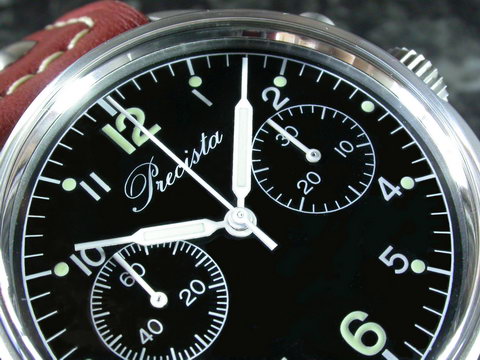
Suffice to say, the presentation case is extremely attractive which is quite a statement from myself as normally I do not give much, if any store to the packaging of a watch. In addition, the watch comes with a Timefactors cloth, International Guarantee and Timefactors business card. I believe that there will be an instruction sheet along the lines of those supplied with other Timefactors watches though my watch was shipped before official release of the PRS-5 and these weren’t prepared at the time. There is of course nothing like opening a new watch when it arrives, especially for me when it is a model that has been anticipated for some time and one that stirs my interest in the way that the military-type watches do. Each and every time a Precista arrives with me I am somewhat taken aback; the first impressions are without fail, thus far extremely good. Of course I have a penchant for the stark contrasts present within a dial of this type and of course I have the same for the simple case designs such as this is; this section is however entitled ‘Packaging’ and this is perhaps what I really mean – the overall package of what at first sight is an extremely well executed watch within a tasteful watch case with no extraneous and unnecessary paraphernalia has the exact effect that I would imagine Precista would wish. Too often in my opinion a watch is cocooned in Fort Knoxian boxes with a plethora of redundant ‘accessories’ to the extent that the article that one has paid a not insignificant amount of money for itself loses its significance. Put simply: the watch should speak for itself, this Precista does so.
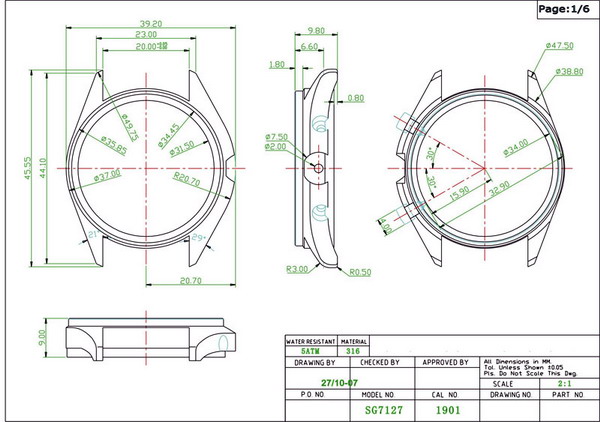
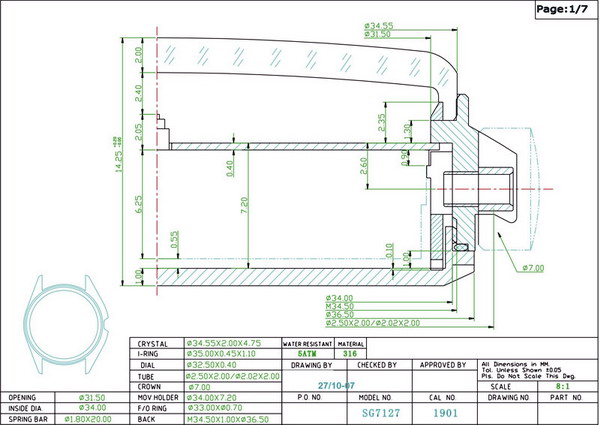
Case and Crystal The original cases used by Precista, CWC, Newmark and Hamilton would appear to have possibly been ‘off the shelf’ designs available to all. Whilst I cannot confirm this as fact, it would seem to stand up to scrutiny. The same would apply to other watches procured by the MOD in the UK, particularly in the instance of the General Service watches of the 1970s and 1980s (indeed, through to today). One mustn’t forget that as well as performance requirements, there were (and are) of course budgetary requirements of any procurement contract. Thus, manufacturers would need to be able to supply at a price that was acceptable to the purchasing body. Precista in its guise of the late 1970s and early 1980s I am certain did not have the capacity to design and have manufactured a watch case exactly the same as that of CWC and Hamilton for example. Nowadays, there are indeed off the shelf cases that can be purchased in order to construct a wristwatch. Far Eastern suppliers are adept at mass producing such things and with the online world as it is, it is becoming increasingly more common to see the ‘same watch with a different dial’ so to speak. In the example of the PRS-5, there are cases out there which could possibly have been bought off the shelf though aside from the currently available CWC chronographs I have only seen one other watch available in recent years in the style of the British military chronograph – this was however far from the mark in many respects. As with all recent watches from Precista, the watch case has been commissioned by them then tooled and machined for them by a specialist manufacturer. This demonstrates to me a commitment to offering a range that is more than just an amalgamation of generic parts to form a whole. The drawings below are part of those used to manufacture the case and give some indication of its dimensions:
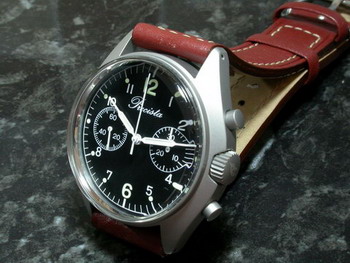
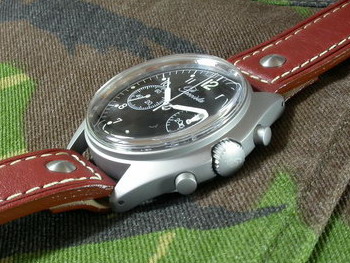
In plan form the asymmetric design is clearly seen and this is true to the originals. This design affords some protection for the chronograph pushers; if they are knocked then it will be the pushpiece that strikes the case as opposed to the tube – this should prevent the tube from becoming damaged. The crown by default is protected from hard knocks by the pushers though as can be seen from the photographs, more than half of the width is within the case cut-out itself. The machining of the case would appear to have been attained within the given tolerances: the chronograph pushers sit snugly and squarely within their recesses; likewise the winding crown. There are no unsightly gaps or poor centering.
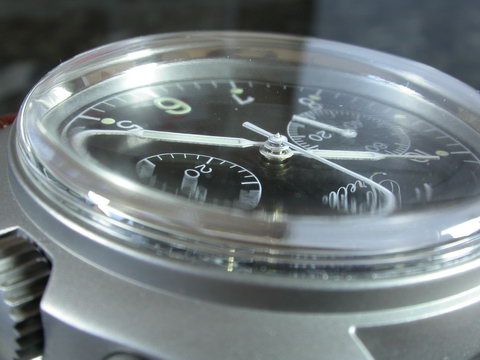
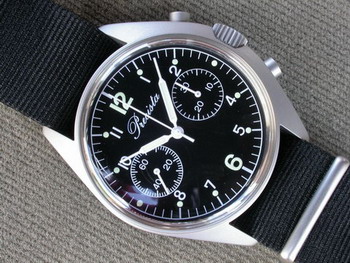
Adding the domed crystal and the caseback gives a thickness of a little over 14mm. This gives the watch more than adequate heft when on the wrist, particularly if the watch is worn on a single piece NATO strap. For some people (at this point in time) the diameter they may feel is not enough. I would suggest that a watch styled such as the Precista would look completely out of proportion should the diameter be increased to cater for current fashions. I am possibly biased in this regard given that I do not have large wrists – however, I increasingly see watches worn which are quite obviously too large for the wearer. At just on 40mm, I see the Precista as a correctly proportioned watch for most wrist sizes and a size that will never look neither too large nor too small. To me it looks as ‘right’ today as on the DEF STAN illustrations of forty years ago.
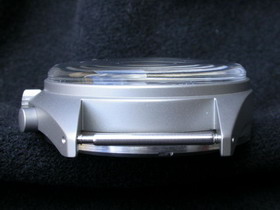
The case itself is executed in a medium sandblasted finish which has been applied excellently. The lugs are cut perfectly and there no signs of rough machining anywhere to be seen. Precista has chosen to equip this watch with drilled lugs and standard spring bars. No doubt this is in deference to those who like to change straps regularly and to whom a NATO strap is not the be all and end all. From a personal perspective, I do prefer fixed bars and the security that they afford; however, the lugs have cleverly been drilled in such a position that the watch will take thick springbars and likewise relatively thick straps. This is a small nit pick from my part but needs to be mentioned for completeness.
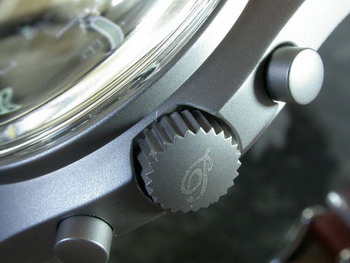
Whilst end on, the watch appears to be slab sided, once one starts to look a little closer then it can be seen that there is a discreet but lovely curvature to the case sides/lugs which is particularly evident on the crown side. It is just enough to give the case some real character and form whilst still keeping it simple enough that it exudes functionality. If one turns the watch over, then the attention to detail becomes even more apparent, the undersides of the lugs are beautifully curved with no machining marks. Lug tips are flattened just enough and the sandblasting has ensured that there are no sharp edges in sight. The quality is every bit as good, if not better than anything I have seen of this type – for example the Sinn 356 that I have reviewed previously. There is no ‘bezel’ to speak of, rather an upright lip to hold the crystal. This does give the effect of the watch being larger than it actually is which should go some way to appeasing the ‘larger is better’ watch enthusiasts. The chronograph pushers and crown are sandblasted to the same finish as the rest of the case with the pushers feeling solidly affixed with good spring. The winding crown deserves some attention on its own. At a very healthy 7mm in diameter it feels just perfect. Apart from the diameter, the serrations are well cut and precise making the watch extremely easy to wind. I have sometimes had an issue with winding the Omega Speedmaster Professional – slightly stiff to wind and hard for me to get good grip on the crown to do so – the latter possibly being due to the bezel. To reiterate, the Precista is a pleasure to wind due to a correctly sized, well manufactured crown. In terms of decoration, the winder has a very discreet Precista ‘P’ etched into it which to be truthful, is so discreet that many might not notice it. It is a nice touch, not military specification of course but it gives a little added touch which many will appreciate – myself included.
The caseback is the only part of the case not to be sandblasted. It features a circular machined finish with six key slots of adequate depth for caseback removal. The machining of the caseback is to me another demonstration of attention to detail; it is quite obviously not a cheaply stamped item. As is the case with all current Precistas, the model number along with brand name, unique serial number and depth rating are all present. Thus, in the case of my example the caseback reads:
|
|||||||||||||||||||||||
 Click on image for a larger version |
|
 Click on image for a larger version |
 Click on image for a larger version |
 Click on image for a larger version |
|
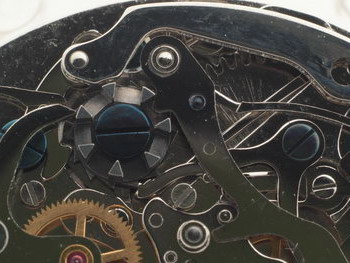
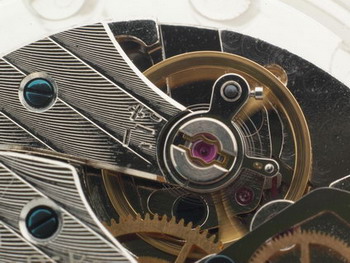
The first thing to note about the movement is just how smooth it is to wind. It truly has that ‘like butter’ feeling that is often used to describe the winding action of good manual winding watches. The large crown I am sure helps to a degree but there is none of the grating feeling which I have experienced with other watches. I shan’t comment on how many turns it takes for me to fully wind the watch as the way I wind will be different to others – there will of course be an actual number of turns of the crown which I have not had the time to measure. As with any manual winder it is always best to back off one turn or so once the watch is fully wound; the click spring on the 1901 is quite strong however in my case habit dictates the backing off that I recommend.
To set the time, the crown pulls out with a satisfying and positive click and I have found that synchronising the minutes with the seconds is fairly easy without too much, if any forward or backjump of the minutes hand when pushing the crown back in. Of course, this movement does not hack (i.e. the seconds hand does not stop when pulling out the crown) so ‘to the second’ setting is not possible. This is an old fashioned watch in all but the date it was manufactured so I am not personally disturbed by this.
When operating the chronograph a firm push is required on the upper pushpiece to start timing; a satisfying ‘click’ is heard and the watch is measuring at 1/6 second intervals given the 21,600 bph of the movement. A further push on the upper pushpiece stops the chronograph and at this point it can be restarted with another push or reset to zero by pushing the lower pushpiece. If the chronograph is left running then the minutes counter clicks over nicely once the central seconds hand reaches the 12. As with most mechanical chronographs, it is more of a rolling over action of the minutes counter than a click - in itself, quite satisfying to watch. On resetting the chronograph then with another click, the hands snap smartly back to zero. I have given the chronograph a thorough workout and can report no problems at all. All actions are positive, there is no hopping or skipping and the chronograph seconds remain in harmony with the constant seconds sub dial.
In terms of autonomy and timekeeping then my example would appear to have a power reserve of approximately 41 hours and the daily rate is approximately +6 per day on the wrist with the chronograph stopped - superb performance and just on chronometer standards. Should the watch slow up a little having ‘settled in’ then of course it will be well within chronometer specification whilst being worn which I find remarkable.
As with any device which relies on pure mechanics to run then a little mechanical sympathy is in order of course and I recommend that the watch is fully wound at a regular time every day to get the best performance. In the case of manually wound chronographs then given that chronograph operation does put extra load on the watch, I tend to wind them on waking in the morning as opposed to before going to sleep at night. Operating the chronograph whilst the mainspring is in a lowish state of wind can cause a mechanical chronograph to stop.
In summary, I am impressed with the performance of the movement in the PRS-5 and feel that its design and specification are perfectly suited to the watch. The facts that it is old fashioned and doesn’t hack are bonuses and I am pleased to finally own a column wheel chronograph, the origins of which in this case date back to the early part of World War II.
Strap
The exclusion of fixed bars on the PRS-5 mean that there can be a ‘free for all’ in terms of what can be fitted to the watch. The lug width of 20mm means that there are a plethora of straps available thus there is almost no limit to styles available for purchasers to fit. The issue Precista of course had a 19mm lug width which meant that it was either an 18mm strap with a gap or a 20mm strap squeezed on. Fixed bars further limited the options available although such considerations weren’t of course of any importance to the British MOD!
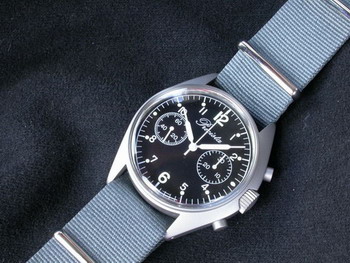
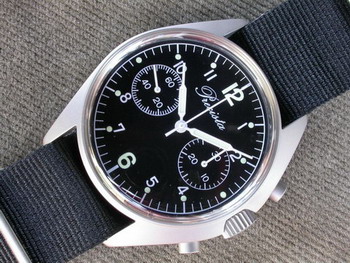
On purchasing the Precista from the Timefactors website, the watch can be supplied on either a Timefactors Aviator strap or a NATO strap, the colour of which the purchaser can choose. Whilst my watch will undoubtedly only ever be worn on a NATO I did purchase both brown and black Aviator straps at the same time to see how the watch would look on something for me, which is different. I have used the Aviator on another Precista and was very impressed with the quality of it. My earlier impressions (which remain valid) follow:
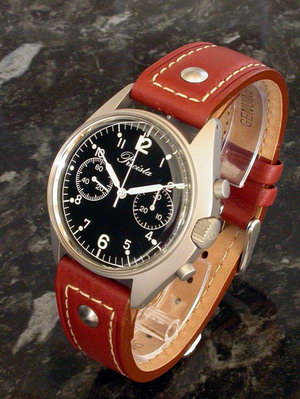
Construction is of four layers of medium softness hide with a matt finish to the top. The sides are cut edge and very thickly varnished/sealed. Thickness all told is 3.5mm and when new the strap is relatively stiff which adds to the hefty overall feel of it. The layers are glued and stitched (with heavyweight thread) together with a good 1mm+ of leather thickness available to secure the strap to the lug bars and at the 'other end' to ensure secure attachment of the brushed stainless steel buckle. The strap is stamped parallel to the stitching which gives a nice contrast to the top surface and finishes the design off well. To the underside and the lining is natural finish; stamped with the width on one side and with the Timefactors logo on the other. Although I am not a leather strap fan for everyday wear I have to say that for a heavyweight watch strap, this Aviator offers exceptional value for money
 Click on image for a larger version |
 Click on image for a larger version |
 Click on image for a larger version |
 Click on image for a larger version |
 Click on image for a larger version |
 Click on image for a larger version |
From the images above it can be seen that the watch certainly suits both the NATO and of course the Aviator. As I stated earlier, many straps will fit this watch and I have no doubt that as time passes internet users will see some interesting combinations of PRS-5s and straps. For me, the watch predictably belongs on a grey NATO where it will now remain!
Price
The PRS-5 costs £210.00.
The value for money that this watch represents is surely unsurpassed if one is looking for a manual wind chronograph with British military origins. For less than one third of the price of the CWC alternative one can purchase a watch which is in my opinion closer to its origins and the origins of others which resulted from the British MOD requirements.
Given the GBP/Euro exchange rate at the time of writing I would imagine that this watch would have been available at £200.00 if things were more favourable. I have decided to consider £10.00 of the £210.00 price tag to be what I have to pay ‘for the name’. I am very happy to do that in this case. I feel that this watch is an early example of what will increasingly become a huge thorn in the side of the likes of the lauded Swiss watch industry as less-greedy manufacturers don’t hide their association with the Far East and offer true value for money.
Conclusion
The Precista PRS-5 is old fashioned in almost all respects.
 Click on image for a larger version |
 Click on image for a larger version |
It (as do other Precistas) captures the spirit of a bygone age in a way and to a degree that many other watches can’t match. Why might this be? It is based on a specification some fifty years old for a simple, legible timepiece for military personnel. It has been manufactured using very much the same design, using features which aren’t the norm any more (e.g. Acrylic crystal) and it using a movement the origins of which predate even the military specification. It is built to an extremely high standard in every way, it performs to a high standard in the same manner and it does so for just £210.00.
I wholeheartedly recommend the Precista PRS-5 to any person looking for a no-nonsense, easy to read, value for money, manually wound ‘chronograph, wrist’.
Available exclusively from TIMEFACTORS (www.timefactors.com)
Thanks to Eddie Platts for use of the SeaGull ST19 image within the Precista case and the original case drawings
Thanks to Markus Bahlmann for use of the ST1901 macro images
|
5.jpg)
7.jpg)